The mathematics behind the patterns
Beyond the Gears
A rolling gear and a wandering pen are the beginning of a surprisingly rich family of curves.
Rolling circles
PRIV
Parametric Roulette Interpolation Vectorizer
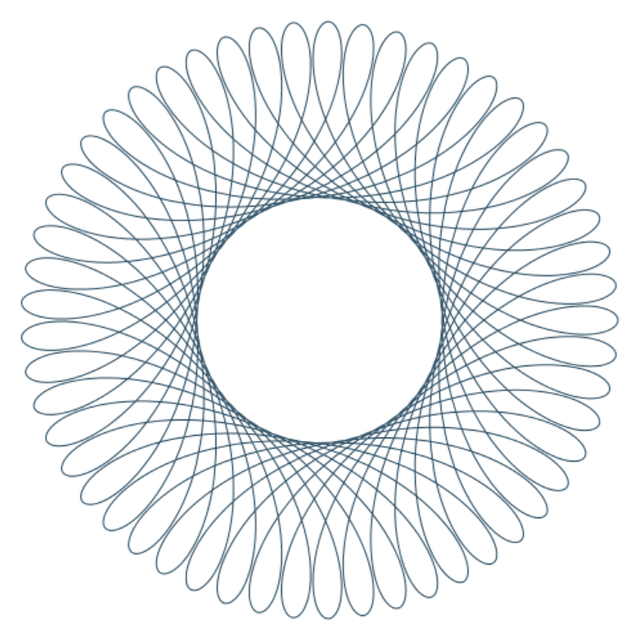
Imagine a pen riding on a gear. Roll it inside a ring or around the outside of another gear and it traces a different family of curves. The tooth counts set the rhythm. Moving the pen turns shallow scallops into loops that cross and weave.
Rolling borders
TRIV
Trochoidal Rectangular Interpolation Vectorizer
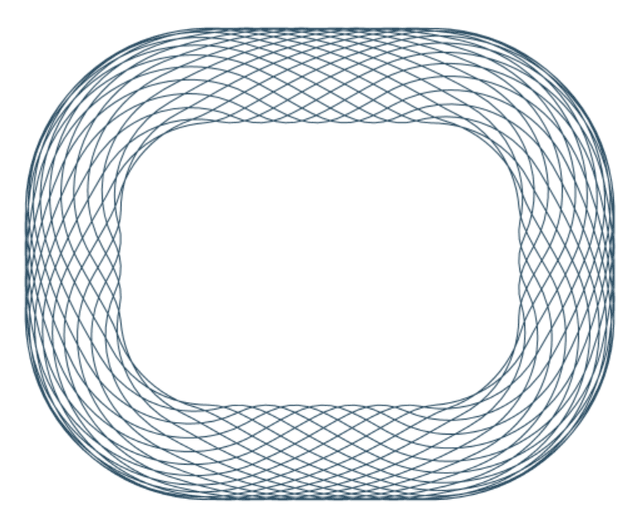
Give that gear a track with straight sides and rounded corners. Choose circular or elliptical corners, then specify the finished width and height. TRIV closes the path and fits the whole ornament to your piece of stock.
How much does fitting change the shape?
TRIV’s Geometric Distortion Index (GDI) measures how much a border’s original proportions change when TRIV fits it to your chosen width and height. TRIV first calculates a rolling path that brings the gear back to its starting position and orientation, so the pen traces a single closed vector. If that vector’s proportions differ from the requested border, TRIV scales it by different amounts in X and Y. Applying that fit to the whole vector preserves its closure and smooth joins. A GDI of 0 means the proportions are unchanged. At 10, a circle drawn on the original border would become an ellipse about 7% longer in one direction than the other. Each 100-point increase doubles that ratio, giving 2:1 at 100 and 4:1 at 200, whether the extra stretch runs horizontally or vertically.
Explore rolling-circle patterns in the PRIV Playground →